Alarm clocks and mobiles: survey results
December 15, 2011 | CommentsSo, I have results in from the survey I was running into mobile usage, alarm clocks and sleeping habits. The survey was live for exactly 24 hours and received 186 responses. Here's a summary for you:
- Demographically: respondents were 75:24:1 male:female:rather not say. Average age of a respondent was 34.96 years; 80.1% were from the UK, 6.45% from the UK, and 1% or less from a large number of other countries. 79% were in full-time employment and 28% had children living with them;
- Clocks and mobiles: 98% of them use some sort of alarm clock, 76% use their mobile as this alarm clock, and 85% of them have their phone visible from their bed;
- Why they get up: 90% said for work, 17% to look after the family, 10% to get up with their partner (they could choose more than one category). Men were slightly more likely to get up for work (92.8% vs 82.22% of women), women slightly more likely to get up for their family (20% vs 15.83% of men);
- Cost of failure: only 5% of respondents said it didn’t matter if they overslept. 72% rated it a medium level of problem or worse;
- Sleep habits: he average respondent thought they needed 7.78h sleep a night and that they were getting 6.69h sleep a night. 52% are catching up on missed sleep regularly. 8% described themselves as “dog tired”, 72% at a medium level of tiredness or worse;
- When they use alarms: no respondent used an alarm clock at weekends only. 81% use one on week-days, 29% use one every day of the week. UK respondents were slightly less likely to use an alarm clock every day (27.5% vs 37.84% for respondents from outside the UK). The average time an alarm is set for is 07:04;
- Making mistakes: men are slightly more likely to forget to set an alarm (55.4% vs 46% for women), whilst women are slightly more likely to set their alarm wrongly (48.89% vs 43% of men);
- How well it works: 28.78% of men and 42.22% of women don’t tend to get up when they planned to; 71% of respondents got up a while after the alarm goes off, and 42% snooze their alarm more than once;
- Device ownership and use: 53.7% of respondents owned iPhone and 32% owned Android devices. At night 67% have their phone charging, 94% have it switched on, and 75% have it connected to their Wi-Fi at home. Men are slightly more likely to have their phone charging at night (71.94% vs 55.56% for women). iPhone owners are slightly more likely to have their device connected to their home Wi-Fi (88% vs 75% for Android owners);
- Night-time rituals: 55% of respondents set their alarm around bedtime (immediately before, during or as they go to sleep). A surprising (to me) 40% use an automated repeating alarm feature;
- Impact of children: people in households with children are slightly more likely to not get up when planned (33.33% vs 28.3%), get up a while after the alarm goes off (73.5% vs 64.15%) and snooze more than once (42% vs 39.6%) - but it’s not a significant difference.
Interesting stuff (for me, anyway!) and thanks to everyone who helped out - some of you will be hearing from me again. And my conclusions from this are:
- As expected, the mobile phone and alarm clock are natural bedfellows;
- Most people get up for work, with a sizeable minority getting up for the family;
- Given that the alarm clock is the sole tool most people use to manage their sleep, it's surprisingly ineffective: most people are tired and have catch-up routines to manage this. Most people don't get up when they wanted to (as evidenced by multiple-snoozing behaviour and a direct question on this point);
- Slightly iffy because the differences are quite slight, but in general men need help remembering to set the alarm at all, women need help setting it correctly;
- It's reasonable to presume that the alarm clock is visible from the bedside, charging, turned on, and connected to Wi-fi;
- Alarm-setting is either a bed-time ritual, or (for a surprising number of people) handled automatically by the clock itself using a repeating function;
- There aren’t significant differences in the alarm clock-related habits of people living in households with children.
So, this - and a Google Adwords campaign I'm running to measure product interest from real people - is leading me towards a product which (a) is a great alarm clock and (b) helps its owner manage their sleep better, as well as getting up in the morning.
Alarm Clock: Thanks for clicking
December 14, 2011 | CommentsThanks for clicking! I'm working on a project to design a better alarm clock, and your click on that ad is going to help me decide which direction to go in.
If you'd like to know more about my project, click here. And thanks again!
Designing a better alarm clock, in public
December 13, 2011 | CommentsThe alarm clock is a standard feature of mobile phones, and an incredibly popular one. More people use the alarm clock of their phone daily than send text messages or browse the mobile Internet; by this measure it's the most used feature of a phone, bar making calls. And yet of all the functions in your phone, the alarm clock is one of the most staid - unaffected by advances in technology, connectivity or our behaviour.
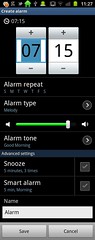 I've been looking at the alarm clock that shipped with my Samsung Galaxy S2. It feels over-complicated to an intimidating degree: separate options for Alarm type and Alarm tone, a selection of possible snooze settings, something called "Smart Alarm" which sits there on-screen bereft of explanation, and the ability to give your alarm a name. 9 input fields, just to say "wake me up"? This can be improved.
I've been thinking for a while that there's some interesting work to be done here, so I'm using a piece of coursework for my MSc to have a look at alarm clocks, from an HCI perspective. To kick this off I'm doing some research into how real people (that's you) use their alarm clocks, and how they manage their sleep-time. So I'd be awfully grateful if you could take a few minutes (literally) to fill out this survey on the subject.
This will be a design project (rather than a research or evaluation piece): I'm going to produce at least a couple of iterations of design for an improved piece of alarm clock software. Now, I've always admired what I've read of Pixar and their process of doing daily design critiques:
"At Pixar, daily animation work is shown in an incomplete state to the whole crew. This process helps people get over any embarrassment about sharing unfinished work—so they become even more creative. It enables creative leads to communicate important points to the entire crew at once"
What I'm working on now is a solo project which won't naturally give me many options to get feedback, and there's no need for me to communicate aspects of the design to a wider group; but I'm still interested in understanding what it feels like to work in that Pixar fashion, and how it could improve the end product.
So I'm going to post regular updates of unfinished work here and invite comment; I think my readership is small enough that I know most of you, and I think you'll have some interesting opinions. And if you've read this far, please do pop over to that survey - it'll give the work I'm doing some grounding in reality.
Update: 3:25pm on Wednesday 14th December 2011, I'm marking the survey as no longer accepting responses now, after 24 hours. Thank you *very* much to every single one of the 187 people who kindly gave up a few minutes to help with this.
Evaluation of X-Construction Lite
December 08, 2011 | CommentsOne of our assignments for Human-Computer Interaction was to carry out a formal usability evaluation of a game. Unsurprisingly my group chose a mobile game, X-Construction Lite, and did a study on it: first individual evaluations using a cognitive walkthrough (AKA "having a play") and referencing Nielsen's heuristics to find and categorise specific issues.
We then did a lightweight usability study by ambushing students outside the campus library and videoing them playing the first level of the game, in exchange for cake (pear tart from Real Patisserie, if you were wondering). Interesting exercise; it's a good game that seems to have gathered nearly 70,000 reviews in the marketplace (and to which we're all now addicted), but our testing showed up some consistent and fundamental problems with the gameplay.
We've submitted a full report, but you can see the presentation we gave summarising the project on slideshare here. Credit due to other team members: Andy Keavey, Queen Atifa Ododo, Mariana Rojas-Morao and Merve Yildirim.
I can't help but direct you to a photo of one of the other groups, showing off their Plants vs Zombies review in appropriate attire.
Tom Hume, On Fire
December 02, 2011 | CommentsThere's a little article I wrote for the Vexed Digital newsletter, over here on their web site. It's all about Kindle Fire and what it means for the tablet ecosystem and Google; I worked it all out the other week, and it only seems fair to tell you.