HCI Diary: surveying travellers and observations on video games
November 18, 2011 | CommentsA couple of entries in one for the HCI Diary, today.
First: observation exercise and surveys.
As I wrote before, we were sent out into the wild to practice our observation skills. The brief was to pick an aspect of public transport and, working in a group, plan and carry out some observations of users and run a survey to gather some quantitative data, then compare the two and present back to the class.
Our group chose to look at the stresses of public transport for those travelling with small children ages 2-8. This involved spending 40 minutes at Brighton station one evening feeling incredibly creepy whilst we identified parents entering the station with kids and followed them through making notes on their behaviour. As an observer it was tough to know how much detail to note down; I tried to get as much as possible, on the basis that it would give us more to work with when doing analysis, but found the more I was writing, the less I was observing. A definite case for pair work, or in future taking notes using something like Griffin iTalk: I could comfortably read out observations and look like I was on a phone call, I think. Alternatively, working very carefully in pairs - one observing, one noting - might help.
This we followed up with a short survey posted to Mumsnet and sent to friends with children of a relevant age.
We ended up watching 5 families in the station, and having 6 responses to our survey. It definitely felt strange and creepy to be watching people: we weren't subtle and I'm sure a couple of them noticed it. As for patterns in behaviour: families tended to use seating in the station, sit for about 10 minutes, go and stand near the departure boards for a couple of minutes, then head to their train. We're not sure why they'd stand near the departure boards before boarding - they're visible from all parts of the station.
The other consistency we noted was the excitement of young children heading through the automated gates. The older kids made a big deal of trying to wander through by themselves (demonstrating how grown-up they were, perhaps?) and there was a tendency for groups to head through the manned gate: mother and children first, father (carrying the tickets, no doubt in case they were attacked by bears) last.
We correlated some data around wait times with that from our surveys; no-one waited more than 15-30 minutes for a train, the majority of folks less than 15 minutes. And about 60% of the survey respondents found ticket machines difficult or very difficult to use (though most used them anyway).
Once again, I found it hard not to be proposing solutions to problems as I saw them. I'm not sure, but I think that one of the keys to doing good observation might be training yourself to avoid analysing: just concentrate on what's around, stay aware, note it down, and plan to think through it all later. I'm led to think about six thinking hats and mindfulness.
The second piece of observation we've done recently was around video games. Pejman showed us a sequence of 10 short video clips of games: game-screen, biometrics of the player, and a video of the player running inset. We were invited to note usability issues and prioritise them; to my mind, they broke into three categories, prioritised thusly:
- The player wasn't in control of their "character", and couldn't work out how to be. This either manifested itself as verbalised frustration ("how do I jump?"), or as staggered or artificial in-game movements (very noticeable in FPS games). This struck me as stuff that ought to be fixed;
- The player was controlling their character, but in an unskilled fashion: they'd drive a car into the wall by the roadside, or jump up and down in a situation where they were trying to be stealthy. Practice would help here, as might instructions, training levels, or a rethinking of controls;
- The player couldn't work out what to do. Going through this pain seems to be the heart of many games - without challenges, what are they - and I noted that in every case we saw, the player worked it out, after some initial frustration.
There were some positives, too: players seemed delighted to notice unexpected depth in the games (the ability to shoot out tires). And there was a little pattern of delight when they got high up and could see far around them (in FPS games), which felt like it might be deeply rooted in our evolutionary history: good visibility means safety, the ability to see threats or food a long distance around. What's not to like about that?
Links for thinks
November 13, 2011 | CommentsIt's been a while since I posted a link-dump, so here's a few that have popped up on my radar recently:
- A brief rant on the future of interaction design: "I call this technology Pictures Under Glass. Pictures Under Glass sacrifice all the tactile richness of working with our hands, offering instead a hokey visual facade.";
- The social graph is neither: "…we have seen the Web, and we have tasted of the blogroll and the lolcat and found that they were good";
- How people use tablets and what it means for the future of news: " A plurality of tablet news users (40%) say they get their news mainly through a web browser. Another 31% use news apps and the browser equally, while fewer, 21%, get their news primarily through app"
More nuances in Native vs web
November 09, 2011 | CommentsI'm collecting signs of people looking at things a little bit differently, when it comes to building mobile apps (mindful, of course, of Kirin, our approach for this). Here's a few I've come across:
- TheNextWeb, commenting on the launch (and subsequent withdrawal) of the GMail app for iPhone/iPad: "…some people pointed out that although Gmail’s app uses web view, it’s wrapped in a native wrapper – effectively giving us the worst of both worlds."
- Matt Asay of Strobe (just acquired by Facebook) writing in The Register, talks about how HTML5-for-apps is playing much better in the enterprise, where traditionally user experience has been seen as less important: "And while HTML5 still struggles to deliver as slick an experience as native app development with Java (Android) or Objective-C (iOS), this isn't much of a factor behind the firewall. Enterprise IT is mostly concerned with delivering a good enough user experience on a cross-platform basis."
- Sticking with Facebook, ReadWriteWeb posted an insight into their approach to mobile apps: "instead of the phone saying I am rendering for a WebKit browser, we send an agent that says you are going to be rendering for a WebKit UI WebKit view inside the iPhone app. So, what you have to do is detect that, style a Web code to make that work, build a bridge between the things that you want to write to interact natively with the Objective-C, say in Javascript, then build HTML pages for Facebok in the iPhone. So, you build much smaller native goop instead of having to build over and over again.".
HCI Diary: Observation of public transport
October 30, 2011 | Comments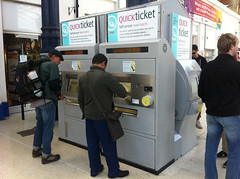 At our last HCI seminar, Pejman asked us to think about commuting, public transport, and the travel experience; consider a small part of this experience, and do some observations on it. So I wandered up to Brighton station at lunchtime today, to nose around.
I didn't have a clear idea of what I wanted to observe, so walked towards the station with an open mind, looking for something interesting. A few groups stood around outside (stations being natural meeting points), and as I walked past the two ticket machines at the station entrance (with a queue of 2-3 people at each) and towards the 5 machines inside the station (with at most 1 person using each), I thought I'd look at ticketing.
Some of what I saw:
- One lady walks up to the ticket machine, after a previous customer has walked away. The ticket purchase is in a half-finished state; she's obviously confused and has to look around the screen to see how to get "out" of this purchase (fix: detect when someone walks away and stop the process for them. Provide an "undo" for those times when the detection fails);
- When making a purchase, several people would not start looking for their credit card when first asked for it - introducing a delay as they went through purse and pockets (fix: see if it's possible to move the entry of credit card to the start of the process, encouraging them to have their cards ready as they queue);
- There was a common behaviour amongst many ticket purchasers, of scraping their hands along the long ticket-delivery channel towards the bottom of the machine: making sure they had all their tickets, every coin of change that had been dropped down there, etc. (fix: smaller slots for delivery of coins and tickets);
- When asking for a destination, the machine displays a keyboard on its touch-sensitive screen, and tries to help by listing all the stations which match what has been typed so far above it, and greying out keys which don't lead to a valid station name. In practice one man had trouble with this: between every key press, he would direct his gaze up, scan the list of stations, realise his wasn't on there yet, scan down, find the next letter of his station, scan up, and so on. Quite slow, and frustrated further by the lack of feedback for any successful key-press and the poor ability of the ticket machine to register key-presses (fix: some sort of feedback, visual or haptic, for a key-press; allow pressing of any key at any time, to lessen the need to glance down to keyboard? Needs more thought);
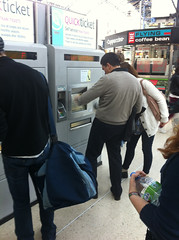
- I saw a couple of instances of two people using the machine at once, one helping the other;
- Another behaviour which popped up was queue negotiation when two machines were next to one another. Was one queue forming for both machines, or one for each? Wordless gestural conversations between queuers and new arrivals seemed sufficient to settle this one;
- About half the people I saw buy a ticket immediately headed towards the concourse, their heads up and scanning the list of departures to find theirs; why not show the next train for the ticket you've just bought on-screen?
- There's a clear and slightly frustrating delay between a customer tapping in their PIN number and receiving their ticket, whilst the ticket is printed (fix: print tickets immediately they're demanded, only hand them out once payment is approved, and accept the loss of the occasional piece of cardboard when a credit card is refused);
- I watched one guy clearly confused by the different types of ticket he could buy (I've had this myself when travelling to London), his finger hovering in the air between several different options before settling on one (fix: label tickets in ways that make sense for travellers, not rail operating companies. Maybe involve restructure of UK rail industry);
HCI Diary
October 26, 2011 | CommentsIn our HCI seminar this week, we wandered over to the more emotional aspects of products and got our fluffy on - kicking off with a group activity that involved drawing a diagram showing the relationship between usability and user experience. Cue lots of chalk-drawn pyramids, balances, and a particularly curious sketch from one team involving leaping frogs.
My lot went with a graph showing usability and UX on separate axes, and plotting a few products on said graph. Whilst logically one might expect usability to be a foundation of user experience, it seemed straightforward to find examples of products which would lead to an after-the-fact warm fuzzy feeling (which one might associate with "good UX") and yet had poor usability: the fashion industry provides lots of examples, I think. Equally I can think of usable products which really don't provide much in the way of joy.
Other factors which occurred to us were how much choice users have (only got one place to get a product? then there's not much competitive pressure for the architects of that product to spend effort making it good), and that usability, being easier to measure, might be more accountable and thus easier to budget for in most organisations, than UX.
It was a strange seminar; probably the most engaged that the (quite large) class has been, thus far, with any topic - which was great to see. But I found it strangely unsatisfying - we kept falling back into term definition ("what is a positive user experience?"), a debate I'm sick to the back teeth of from certain segments of industry, and was hoping academia might avoid. And we found that ranking criteria for user experience objectively would depend on the product - so every answer tended towards "it depends". I'd like to do the same activity with a couple of specific products in mind, and maybe be encouraged to think negatively: what, of this list of lovely fluffy adjectives, would you not prioritise?
I am really looking forward to the exercise we were set, though: to think about the experience of public transport, consider a small part of it, do some observation, and think about how to do interviews and questionnaires around it. Really hands-on practical stuff, to a depth I've not gone in my career. If you're in Brighton station next week and I loom towards you with a clipboard, please don't be frightened.