Mobile 2.0 Europe, Day 1
June 16, 2011 | CommentsCunningly scheduled the two days before Sonar, Mobile 2.0 has snuck into my calendar for the last few years; and with Rudy knowing everyone in Europe, it's a good opportunity to meet a set of people I don't bump into around London (LIFT is similar, but perhaps more biased towards academia and away from the Mediterranean).
A combination of a late arrival in Spain the night before, an hour or so preparing slides for my talk tomorrow, complicated travel arrangements and pure laziness meant that I missed the very first session. I arrived at the impressive venue (Telefonica R&D HQ, I'm told) to find Peter Vesterbacka of Rovio, proudly displaying a bright plumage of Angry Birds merchandise and talking about their meteoric rise to fame.
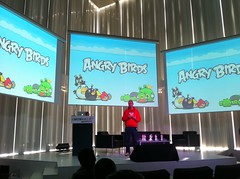 Peter's an old face on the European mobile scene and there's a sense that - much as with Russell Buckley - he's someone who's put the time in and is now reaping his just rewards. He's quite disarming, pointing to the 51 games they released before Angry Birds (which now coasts at 1m downloads a day), and presents Roxio as not a unique success, but rather part of a broader trend: mobile is a good place to build entertainment brands thanks to its wide reach and ability to engage daily. Compare production costs for mobile games with anything that might be produced in Hollywood; look at how Roxio roll out seasonal variants and regular game updates.
"We're not a mobile games company, we're a next generation entertainment franchise", he squawks. Rovio were a service business of 12 people (a similar size to FP), who successfully made the move into products. My feathers ruffled by jealousy, I nonetheless enjoyed hearing Peter talk so disarmingly about his business.
A panel discussion followed. Much of it covered well-trod ground (gamification, augmented reality and the importance of context) but the panel covered it well. They were united on the importance of context awareness, Which seems to me to be somewhat similar to targeting of advertising: mining a large amount of raw data, mining it and drawing conclusions from it. Given the internet and mobile advertising industry's failure to deliver on the promise of well targeted advertising over the last 15 years despite the vast amount of data ISPs and operators own concerning their customers, I found it hard to share their optimism about our ability to reliably derive context from sensor data? What will happen here that hasn't happened with advertising? I suspect that deriving anything reliably useful about context from a mass of sensor data is a Really Hard Problem... Though thinking back to Ted Morgan talking about work Skyhook had done in this area in a talk here 2 years ago, there seem to be some opportunities lurking in the short term.
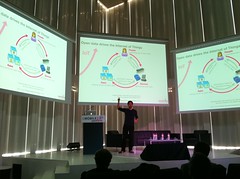 Usman Haque was up next to talk about Pachube, an amazing service I keep hearing about, getting enthused for, and failing to do anything with. They're am aggregator of sensor data, and Usman presented a stirring and deliberately contradictory Bill Of Rights for the Internet of Things. Definitely worth more attention.
Di-Ann Eisnor of Waze followed up with a talk about the participatory city - essentially some use cases for the kind of data that Pachube is gathering, focused around some nice demos of her product. Waze looks to be a journey optimiser, using realtime traffic data to better inform drivers of routes to take.
Another panel: the panelists dwelt a little too long on the role of government in regulating or otherwise facilitating open data for my liking. Not that it isn't an important topic, but I'm more of a nuts and bolts kinda guy. Having spent a few evenings recently watching Adam Curtis' documentaries, I was driven to wonder how helpful it is to employ the metaphor of city as computer. What do we run the risk of losing by viewing our social structures - which aren't digital - through this lens, and how can we avoid losing it? It feels to me that nowadays if we measure something (school grades, say, or NHS waiting times) we are driven to optimise for the thing being measured, at the expense of that which can't be measured (a well-rounded education, say). I wonder if this is a valid concern, or just the first signs of my turning into an old man bemoaning contemporary society?
Coffee, and I'll confess I didn't follow the next couple of talks too closely. Andy Goodman of Fjord Madrid gave a thousand-foot-view of the Fjord view of the world; WorldReader seemed a worthy effort to put e-reading kit into the hands of pupils in the developing world.
AppCircus closed the day, and once again I was struck by how many really nice-looking apps (such as Nomad Analytics, who did a good presentation of what looks like an excellent Blackberry front-end onto Google Analytics) didn't have much of a solid business behind them. Sign of an app bubble, a congenital weakness in European startups, or me missing the point of what AppCircus is? I'm not sure. For me, iscandit stood out as a business with IP, a good-looking product, and some thought as to revenue and likely partnerships.
Checking back on check-ins
June 16, 2011 | CommentsVia Mr Falletti, I notice that the BBC have posted a review of the Facebook check-in project we ran for them at the Radio 1 Big Weekend, including a load of video footage with attendees. As he says, it's very frank and complete:
"Even though we had some initial teething issues, the research from the audience and on site analytics showed that the audience really liked sharing their unique experience with (or bragging to) their friends.We had large interaction spike from the news story posts from seeing a high number of 'likes' and 'comments' on each of the check ins. This interaction was exactly what we were trying to achieve and it really worked. Interestingly, the stats also showed that more women engaged with the product rather than men - something that needs to be investigated further - does social syndication in this way appeal more to women than men?"
UXCamp Europe
June 14, 2011 | Comments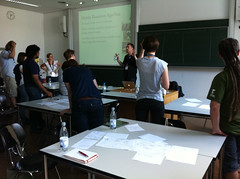 Really enjoyed UXCampEurope. I've attended a couple of the London events, and got a lot out of each one, so was quite happy to have an excuse for a weekend in Berlin... And wasn't disappointed.
From the moment we arrived, it was all very smooth. A great venue on the outskirts of Berlin (slightly awkward to get to by S-Bahn, but not so much that it derailed anything), huge and light; excellent food; and great facilities. A couple of the rooms got quite crowded and could have done with better air-con, but that's probably more a comment on the popularity of those sessions than on the venue.
There was a good selection of talks; a couple of times I was forced to skip one I really wanted to see (like Eva-Lotta's sketching workshops). Maybe one fewer room would have forced us to fill all the available time-slots instead of spreading out and leaving too much choice... Amongst the talks, there was a heavy emphasis on Agile/UX, and also on tool use: lots about Axure, and a couple referencing Balsamiq.
Highlights for me were the two sessions run by Anders Ramsay on user stories (wonderful analogy: software development is a restaurant, with the kitchen being development and front of house, UX) and the design studio workshop. Honorable mentions to Design For The Toilet, an examination of and call for data-driven design to the exclusion of our own instincts, which the speakers ably demonstrated were wrong; and an examination of a recent redesign of Doodle, one of my favourite web services.
Eric Reiss rounded off the first day with a warts-and-all show-and-tell of disastrous experiences running a design agency, and uncomfortable number of which rang bells; and I had a fascinating and intimate chat in the final session, on bringing design to the often code-emphasising world of open source projects.
War Horse
June 08, 2011 | CommentsI wandered up to London last night with Ellen to see War Horse, a rather interesting show based on a World War 1 story, using a variety of life-size puppets. Puppets are Ellen's thing at the moment (she did a couple of shows during Brighton Festival), and I rather enjoyed Flogging a Dead Horse when we caught it last year.
I found the script of War Horse slightly on the mawkish side, and long after having shared a house with an academic who specialised in the subject, I still find World War 1 material challenging in general. But that didn't matter one jot - I was absolutely blown away by the technical mastery of the puppets, the unnervingly lifelike movement ascribed to them, and the playfulness with which they were employed. You haven't lived until you've seen a wheeled mechanical duck get pushed around the stage in a waddling motion, it's eerily articulated neck pecking at the floor.
Over and above the relentless detail of the animal movements, a few moments really hit home: watching a trio of puppeteers slowly withdraw from the corpse of a fallen horse, driving home the finality of its death; one of the cast casually slapping one of the "horses" on the rump during the final applause, to persuade the artificial beast to leave the stage; and the insistent pestering of a young French girl for chocolate. By the end, the animals may as well have been real; their suffering certainly was. And yet they're strange things constructed from wood, wire and leather - not by any means real, they ought to sit snugly in the uncanny valley.
I couldn't help but relate my own empathy with War Horse to some of what I saw Sherry Turkle talk about last week: I *must* hurry up and read the first half of Alone Together, which deals with social robotics.
And Ellen talked about a modern renaissance in puppetry. I idly wondered if something about our relations with software and machines might have trained us, or at least acclimatised us, towards relating better with this particular art form...
Operator app stores: oh dear, oh dear, oh dear
June 08, 2011 | CommentsWe're having an interesting experience at the moment with "operator app stores". We've submitted our Guardian Anywhere app to a couple of them. It's a fairly popular app: 60,000+ downloads, 4.5 star rating, 27,280 active installs and well over 2 million copies of the Guardian delivered through it.
I won't name names. Let's call the operators concerned A and B.
Initial reaction from A when we submitted the app was to reject it, because A can (I quote) "already supply news feeds through its own and third-party services and there is no additional requirement for these type of products".
We've since resubmitted it to A, through their portal which they're using to liaise with folks like ourselves. We submitted it on 30th March, and their site says it should go through in 10 working days. As of the end of May, it wasn't live and the folks at A weren't able to say when it might be (the connection their UK application shop wasn't "live").
Operator B, on the other hand, rejected our submission "due to your app containing ads or links of any sort, which is currently prohibited for applications held within B's app store". I'm still picking pieces of my jaw off my desk.
We have no advertising or other revenue tied to this product - I'm not moaning because we're out of pocket, and my interest in getting this sort of distribution is purely to compare operator app stores to the Android Marketplace.
But it feels like operators are repeating mistakes they should've learned from 5 years ago, and aren't learning from the success of app stores. Launching through them is a cumbersome process with hefty manual reviews and curation. Even a manual review process from Apple doesn't take 3 months, reject your app for containing links, or say "no thanks" because they already have an app in your category.
Update: I've been working on mobile so long that I'm quite bored of operator-bashing. After seeing quite a few folks pick up on this and get busy kicking the operators, I thought I'd try and be a bit more constructive.
I think it all comes down to clear communication: anyone distributing apps should say, clearly and concisely, in a single place, what their standards for accepting and rejecting apps are; what apps they are and aren't interested in; and what their timescales for launch will really be. And then stick to them.