LIFT10: Hacking Venture Capital, Fred Destin
May 07, 2010 | Comments Hacking Venture Capital, Fred Destin
Part 1: pitching. Part 2: negotiation
Fred is a VC focused on early-stage funding for consumer-facing innovation: e-commerce, digital media. Moving back to the US, he's the only guy left in Europe.
We split into groups of 4 and work out how to pitch a fake company; a few groups pitch; we get harsh feedback.
Our group got up and pitched a fake version of Seedcamp winner ERPLY. Feedback on our pitch:
- Introduction was boring; everyone knows the small business market is huge. Liven it up with a personal anecdote, perhaps. I did this bit, and completely failed to use a great line one of the guys in our group came up with: "We're SAP for small businesses";
- We pitched our use of Amazon as a competitive advantage; this didn't add anything and wasted time;
- We didn't have a clear conclusion;
- Asking for investment in exchange for a stated 30% investment was poor practice;
A pitch is all about honing the story. To get good terms, you need multiple offers; to get multiple offers you need to tell a good story to several investors at the same time. Investors buy stories not businesses: they fall in love, then post-rationalise. You should be able to summarise your company on the back of a business card.
A decent elevator pitch is also a good tool for sharing a vision internally: it's a recruitment tool.
You don't need a business plan, executive summary or NDA. I've never heard of an NDA being enforced.
You need introductions (through an investor/entrepreneur); a high-concept pitch (3 words: "flickr of video"); a bottom-up, assumptions-driven model with any real numbers you can get in there. A model that an investor can play with and stress-test. An operating plan for next 12 months. Very clear milestones and deliverables. An explicit technical roadmap (not engineering documents, an outline). 10, 15, 5 KPIs by which success is measured (read Dave McClure, etc.). A cap table. Possibly credible market sizing.
Presentation doesn't matter; real-world traction is the most important thing. You're selling yourself: use social proof, if you don't have money you can find it in the ecosystem.
Elegance of product is important.
Tell a story; release your inner actor; smile; be true to yourself; raise pulse levels. Practice, practice, practice.
Let the audience have "aha" moments, so they feel they're smart and discovering things about your business. You're not allowed to have doubts about the team though.
In Europe, we have a tendency to be so fucking humble... err on the side of being salesy.
Embrace "pitch decay" - initial excitement decays over time. This is why you need to leave people with key takeaways. The VC you persuade will be your champion, and is now your sponsor - help him, make his life easy.
Be Israeli: doors close, come in through the window. 3-5 days after a meeting, follow up. No answer? Wait 2 days, follow up. VCs are busy and forget things, don't take it personally. Be pleasant enough that a VC could happily spent 8 hours stuck with you at an airport.
Part 2: negotiation
We split into teams of two: one team is investors, another entrepreneurs. They get different information on the company and their needs and negotiate. This was fun :)
Real-world valuations: they want to own 20-25% of any investment. So what's a reasonable price?
The only thing that really matters is price per share: bring it back to this every time. Option pools are important to build strong teams and legitimate but affect this.
Don't let investors tell you the size of the option pool (though they can provide useful input). Use a hiring plan to justify a small option pool, increase your share price and increase your effective valuation. Underestimating the size of the option pool is a classic mistake.
Liquidation preferences are designed to push the valuation hurdle out and ensure investors get their money back.
Boards are important. Companies are benevolent dictatorships; the board exists to ensure he's optimally benevolent. The CEO works for the board. Bad dictators get beheaded...
Legals are designed to cover a downside - you get run over by a bus and investors end up dealing with your heir. Don't take them personally. Secure the social contract: companies always go wrong at some point, and big companies have big problems. Documents don't help here, but a social contract will.
LIFT 2010: What's up with online communities?
May 07, 2010 | Comments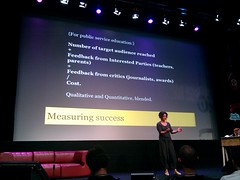 The Transition from Broadcast to Multiplatform for a public service broadcaster: getting attention and measuring success, Alice Taylor, Channel 4
Channel 4 Education's target audience is (will be) 12-19 year old. They weren't watching much TV in the morning slots, so now CH4 go where they are: online.
One myth about teenagers is that they have the latest technology. They don't: it's mostly broken, hand-me-down. Only 1/4 of teenagers self-describe as mainstream.
In broadcasters, digital projects are usually "support". That's not the case for Alice's folks. An hour of TV usually costs 100k (40-60k if it was cheap, 150k if it was expensive): a rough audience of 100k for £100k. Can online do better?
What kinds of things? Games, TVs with tools, TV/app blends. Not much iPhone (3.5% of UK have iPhone, a subset of them are teenagers). The majority is on games.
In the UK, all top 10 destination sites for UK teenagers are American.
Using Bittorrent for distribution of Science of Scams. Unusual for a broadcaster.
Success is a combination of number of target audience reached, feedback from interested parties, feedback from critics, divided by cost: a blend of qualitative and quantitative.
Games lead to long dwell times: 15-25m. TV *can* do, but adding things around it (a celebrity for Science of Scams) can help.
Jean Burgess, Youtube's unfolding history
Youtube is 5 years old this year. Started as a dating-ish site. Youtube was underdetermined from the very start. Bedroom as vaudeville stage. Large proportion of content was video-blogged, a format that predates Youtube. A subset of the Youtube community sees itself as, and functions as, a community. The most subscribed channels have emerged organically from this "Youtube social network" - very few are large media brands.
Is Youtube a file-sharing/piracy site? No. The company is quarantining off big media into curated areas, away from the messy activities of Youtube users. Youtube is the biggest museum of television in the world, but its content has been selected collectively by its users - so it's an archive of public culture and has public value even though Youtube is not a public organisation.
Then there's remix culture: Downfall parodies, say. The messiness of our everyday practices when it comes to audiences or producing content are not compatible with the dominant business logic of the broadcast media.
Participation in user-created content is not universal.
Tabs...filling... must.... make.... space...
May 06, 2010 | Comments- PatientsLikeMe, crowdsourced health information;
- Starling, a social TV platform. I think there's going to be so much mileage in this stuff... television is a social medium;
- The literary platform, a top-notch blog covering publishing and digital content;
- The data-driven life: "without good time calibration, it is much harder to see the consequences of your actions. If you want to replace the vagaries of intuition with something more reliable, you first need to gather data. Once you know the facts, you can live by them.";
- The Five Second Test, for getting quick feedback on designs;
- Realtime visualisation of European flights, particularly lovely to look at whilst they were all volcano'd out;
- No Bugs: "This isn't a matter of finding defects earlier; it's a question of not generating them at all"
- Designing for iPad - a pile of practical hints, tips and thoughts on iPad UI;
- SCVNGR, a very interesting-looking Google-backed location-based gaming platform;
- Authenticating against App Engine from Android... slowly, slowly, tying all that infrastructure together...
LIFT2010: The Old New Media
May 06, 2010 | CommentsMedia, audiovisual content meets the digital universe: Catherine Lottier and Virginia Mouseler
Dividing lines in content are blurring: fiction/documentary, say. We now have hybrid genres: X meets Y (fiction with a bit of documentary benefit, documentary with a real-TV aspect to it, mix of real and virtual worlds.
On 9/11, CNN was a major news source for officials, never mind the public. Nowadays events come to our attention not via TV/radio, but social networks (think not just of the recent volcanic ash, but of the Mumbai attacks in 2008).
Visual codes of the digital universe (URLs, hashtags) are migrating into broadcast. Instead of story-telling, immersion. Comment culture: lots of programmes are now comment on other media, whether it be satire (The Daily Show).
How does this change things? See The Execution of Gary Glitter in the UJ, Mes Cheres Etudes in France, or The District in the US.
Also showed a clip of "Stand out from the crowd", a new Noel Edmonds property which looks like it was written for Charlie Brooker to take the piss out of. Edmonds' face bursts out of advertising hoardings to offer innocent members of the public a chance to WIN CASH PRIZES.
Mercedes Bunz
Algorithmically generated news in the US: "not to replace journalists, but to deliver material that journalists can build on".
"Newspapers produce masses that don't even need to gather"
Design principles for Mag+: Bjorn Jeffrey, Bonnier R&D
- Silent mode. Less distractions. "Continuous partial attention" is a good thing in many ways, but not all your media experiences should be that way. We thought of interactivity in terms of layers: just as you have silent mode on a phone, you should have it in a magazine. It starts silent, but when you decide you want more it can move from passive to immersive.
- Clearly defined beginning and end. Simple linear flow, a defined storyline, a sense of completion.
- Designed for the screen. Don't make the user zoom in or out, make the content constantly readable.
- Advertising as content. People like advertising as long as it's relevant.
LIFT 2010: Politics session
May 06, 2010 | Comments Digital Media and the Future of Politics - Rahaf Harfoush
How are social networks and collaboration technologies changing the way we support and influence governments and campaigns?
What did the Obama campaign do that was different? MyBo.com allowed participants to connect, blog, write, demonstrate support. Traditionally candidates ability to reach into different states was limited by their resources - it's expensive to reach lots of states. This tool let the campaign tap into a network of millions of volunteers, who could self-organise.
2 million profiles created in 2 years; 35,000 volunteer groups created (e.g. "Chihuahua owners for Obama"); 400k blog posts; 200k offline events.
Traditionally voters would be distanced from a candidate - they'd see them on TV news, but that's it. With this campaign you'd be reading their thoughts on the blog, see cameraphone pictures from the campaign team, see unscripted moments (e.g. Obama playing basketball). This bond translated into a feeling of closeness to the candidate and personal investment in seeing them succeed: supporters become friends.
The McCain campaign raised $360m, the Obama $750m. In September 2008 Palin said that she felt campaign organisers didn't have impact. The Obama community was built on the opposite belief: that anyone can get out and make a change. This galvanised Obama supporters into demonstrating what their community organisers could do - in 24h they raised $10m. By end 2008, they'd received $150m, two-thirds from online.
Today there's a focus on open data and transparency in government. The community that supported Obama in the 2 years before he got into the white house aren't going away.
The Sunlight Foundation works with the Obama administration on data.gov and recovery.org (to track spending related to the Recovery Act).
Google are mapping government requests, to see how governments are interacting with our data.
Ushahidi.org: a citizen journalist site from Kenya which allowed people to report instances of threat to the political process: took something not spoken about and made it open to the world.
Social media made the Iran protests something larger than "just inside Iran" - e.g. green-tinting of avatars to draw attention. Effectively, people who weren't in Iran were expressing a desire for the story to be given prominence.
In Rhode Island, citizens are looking for a new Mayor and are rethinking the political process with Uncaucus: putting out a job description, deciding what the role of the mayor is. In Canada, an unpopular decision from the prime minister Stephen Harper to dissolve parliament led to a Facebook campaign to see if an onion ring could get more fans than the prime minister - it could.
In Mexico, drug dealers are using Facebook and Twitter to support their business (e.g. tweeting about government roadblocks). Governments there are writing legislation to monitor and regulate these tools. This legislation will include creating a police force to monitor social networks. They're considering banning Twitter (as in Iran they're banning access to GMail, and in China they've banned Facebook). Expect more of this.
In Kurdistan last year, 80% of their bandwidth was taken offline for two weeks, just as the government was taking pressure from Russia to shut down a US airbase... once the parliament voted to shut the base, the attacks stopped.
US Government asked Twitter to postpone scheduled maintenance, so USG could monitor the election situation in Iran.
Retweeting something isn't getting involved.
Q: Do you have any examples of how to combat hijacking?
A: On MyBo you could organise meetings in your neighbourhood. There were lots of examples of people organising meetings against Obama. It's important for your supported to understand the mission, that they become your advocates. You can't control everyone, you can't be everywhere at once - but you can turn your community into your eyes and ears. We had our community spotting these groups, eventually. Objectionable content was spotted and removed within two minutes of it being posted. This is a risk that comes with the territory.
 Claudia Sommer, Greenpeace Germany: Greenpeace social media strategy and on-line campaigns
Greenpeace has done mass-media comms for decades. What we do now is "open campaigning" - giving people more opportunities to get involved. In Germany we have some obvious problems solved, but the big ones (climate change) remain. In the past we've pushed these into the spotlight with TV or print campaigns. We need to create peer pressure and visible actions. We will do this by getting in touch with people who are already active and who are willing to mobilise others.
Facebook and Twitter work well for us (8700 and 8100 fans respectively). Flickr is interesting for us, we want to publish our photos under Creative Commons but it means renegotiating rights with photographers. At the same time we think it's important for us to be independent of any one social network.
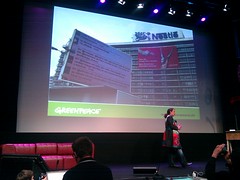
Greenpeace can't solve issues like climate change alone; we need wide public support. If we campaign against Nestle, say, it's important for us to have good backing - they own large media companies. GreenAction is our platform to kickstart online campaigns: it's independent, with no advertising, political parties or companies. Initially designed for Greenpeace, it is available for other environmental campaigns too: "open source" campaigns.
8 months in, 6050 registered users, 15-20% launch campaigns (500 so far). Three different user groups: individuals, campaigners, organisations like Bund. There's a tendency to "mash up" (or combine) similar campaigns. Very few terms-of-service violations.
Shows the Nestle Killer campaign, which they started on GreenAction. Just over 5000 people involved on the site, spreading the message, talking to Nestle directly via Twitter. They took a digital Twitter-wall to Nestle. The story in German press discussed the Twitter-wall, but no-one mentioned Greenpeace: this was very successful. They've reached 1m people via these tweets.
Gorleben campaign, where documents concerning the siting of a nuclear waste storage facility in Germany have been digitised, placed online, and made searchable.