LIFT 2010: Generations
May 06, 2010 | Comments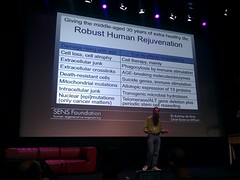 Aubrey de Grey: Prospects for regenerative medecine against aging
Aubrey doesn't work on immortality, he works on aging, for a US nonprofit called SENS Foundation, interested in combatting aging using regenerative medicine.
Death from aging isn't just "natural causes": it's anything that mainly kills old people. Don't think about longevity, think about keeping people healthy. When we're good at this, people will live longer - but that's a side-effect, it's not the main purpose. 2/3 of the 150k people who die every day die of aging (90% in the industrialised world).
And aging isn't fun, even if you don't get nasty diseases.
Being old and frail is extremely expensive: $200bn p.a. in the USA alone. The last year of life, if you're over 60, costs more than the rest of your life. So it makes economic sense too.
Why is aging defended? Rational denial: it's both ghastly and inevitable. And it's rational to put ghastly inevitable things out of our minds. But what if it wasn't so clearly inevitable? Aubrey thinks we'll have a big effect on it within our lifetimes.
What is aging? The accumulation of damage, the side-effects of normal metabolic processes. Our existing treatments against aging are "the geriatrics approach": trying to do something about the pathology of old age. This is a losing battle. The other approach (gerontology) is that prevention is better than cure: clean up metabolism by slowing down the accumulation of damage.
But metabolism is incredibly complicated: we only understand a tiny amount of it. If we try and interfere, we'll fail.
In the "maintenance approach", we don't try to slow down the creation of damage, or its consequences: we repair it periodically. Damage isn't complicated, compared to metabolism. Damage is junk, cells, mutations and protein crosslinks. No new types of damage have been confirmed since 1982, we can be confident this is a complete list.
This would lead to an extra 30 years of human life. These are all maintenance therapies, applied to people who are already middle-age: making 60/70 year olds biologically younger.
Longevity Escape Velocity: the rate at which rejuvenation therapies must improve to outpace the accumulation of so-far irreparable damage. By the standards of most technologies, we're going fast. So anyone getting first-generation treatment should live for as long as the therapies keep developing.
He has a book; is interested in donations of money, or research time.
 Doomed to be forever young, Antonio A Casilli
Shows his cousin and grandmother using MySpace and Youtube respectively. What does "digital native" mean?
There is no empirical evidence for digital natives. Not all children are computer-savvy (there's strong variability in language/linguistic skills/etc/). The situation is changing quickly and sharply.
The myth of "wired kids" was created in 1982, and has flourished ever since. Let's look at artifacts (computers) and how they've been at the centre of two social dynamics: reterritorialisation (computers have changed the place where they sit: military bases to factories to offices to households) and miniturisation.
The commercial names of computers performed a "dismissal of adulthood": the Piccolo, the Husky, the IBM PC Jr, Microbee, Apricot, Apple. The worst performers in the market: Vixen, Power 10 Cortex, Dragon, Charlemagne.
Why this dismissal of adulthood? Economic reasons: younger generations buy high added-value services, so are targeted by more aggressive marketing campaigns. Cultural reasons: technology associated with a futuristic optimism (post-Big Brother), leading to a change in our perception of age cohorts and generations. Political reasons: the divide between digital natives and immigrants mirrors a real-life divide between old and young that we see in real life.
Actually, digital natives never existed. Economic, cultural and political factors account for the creation of this myth. With 2bn people online, perception evolves.
 How is my generation being transformed by technology: Julian Zbar
Anyone my age is an expert on the Internet. We are no different to any other generation; some preconceptions about us are true, some false. We've not known a world without the Internet, it's a given for us. One physiological change: the Internet is our extra limb. We're as cost-conscious as you, but expect everything to be free.
Connectivity is no longer a luxury, it's a necessity: whatever you're doing, you need to be connected to the Internet. It's not as important what you're connected with.
Everything beyond hardware should be free. What we do on the Internet has no monetary cost, there's no opportunity cost for us to be online. We don't consume out of necessity, but there's lots of music I wouldn't own if its ownership had meant giving up something else.
We're accustomed to receiving an awful amount and giving back nothing at all. The internet is feeding us all the free lunches we can stomach. You wouldn't download a car? If I could, I would.
Short attention spans. Interchangeable sources. Instant information. When it becomes so easy to get something, you have less interest in it. Articles would be more interesting if I had to wander somewhere to fetch them.
We discard the things we don't like, rather than choosing the things we do like: choosing things takes too much time.
The Internet follows us everywhere. We are never doing nothing. Don't confuse this with exponential growth in productivity, it's just very easy to fill every waking moment with activity.
On social media: 2 years ago a few people were resisted, today everyone has a Facebook account. Being social is no longer an active decision: your social scene falls onto your lap without your wanting or seeking it. Facebook is a paparazzi magazine of everyone you have ever met. The beauty of meeting people and forming relationships has been lost. When you meet someone, you already have a great deal of information about them: it changes the way you act even when you're not using it.
Everything is classified and exposed: like, ignore, add, etc. Social actions are trivialised: judging, rejecting, commenting is all less important. You don't get the human reaction to your own actions in front of you.
It's easier to use Facebook and Skype to say difficult things; it's as though we're forgetting the spontaneity of conversation. Like road rage, two drivers sitting in their cars and cursing each other for a trivial motoring incident.
No-one is consciously worrying about privacy. Google stalks your searches, Facebook knows your social info. How can you worry about your privacy?
Every situation is documented and exposed. Little judgement is given to what is put up. This distorts our scale of value: everything is consistently and repeatedly replaced by something new.
Twitter doesn't add any value over and above a Facebook account. It hasn't caught on for my generation in Switzerland.
LIFT 2010: Privacy and Identity sessions
May 05, 2010 | CommentsMutual privacy and online distributed social identities, Olivier Glassey
Is "public" the new social norm? "Apparently" privacy is ending, is this maybe wishful thinking sponsored by the large harvesters of personal data? There's a false assumption about digital natives, that they don't know/care/do anything about privacy online.
Many people are still playing with their identity online and working out the connections between it and their "real world" identity. Most people will accept friend requests from people they don't know. Also references the Burger King Whopper Sacrifice site.
Much of our identity online isn't down to us, it's down to the framing we get from the types of communities we enter - e.g. beautifulpeople.com, which expels users who no longer meet the community's standards of good looks.
We all switch roles regularly in everyday life - we speak differently to strangers, colleagues, parents, friends. How do we account for this in technical privacy control settings, which are frequently "black boxes" for users?
Bearing this in mind, how "social" are online social networks, anyway? They seem to be missing key elements of real-world sociality - the constant changing of roles, for instance. Can a coherent personal presentation be built, given these sorts of restrictions? We need social memory and social amnesia; forgiveness at different scales (for e.g. individual reputation, youth protection, and criminals who've repaid their debt to society).
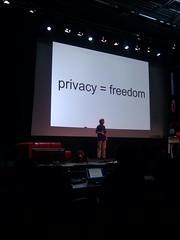 Post-privacy, Christian Heller
Believes that privacy as a guaranteed personal space, free from outside view, is gone. Privacy will survive as an exception not the rule.
We consider that privacy = freedom. I think this is flawed. In a medieval village, no-one had any expectation of privacy; there was a strict self-control driven by constant observation from others. Those not obeying community rules was caught and punished. The nobility had entirely public lives: all details were public and political. The post-Renaissance middle class had no private spaces, with everyone sleeping in the same room (or same large bed). Later rooms were separated by function or owner (e.g. dining room, or room where the servants sleep). Private personal spaces developed from this environment.
Male/female roles map to public/private: woman stays at home, whilst man goes out to earn, vote, participate in public discourse. Female emancipation suggests that the "privacy = freedom" equation is not enough... because private spaces can be isolating. The sexual revolution of the 20th century was about taking much private content and making it public; the gay movement is another example of privacy (where homosexual acts were tolerated) being isolating/limiting.
All examples where taking things from private to public can be positive.
Nowadays we can choose a society to which we already conform (e.g. online S&M communities) rather than being forced to live in the society in which we reside.
PatientsLikeMe.com - all about opening up the healthcare system by having patients share their data.
Privacy has been associated with rights, e.g. self-determination. We have a perception that information about me can be used to exert power over me; urban CCTV is an example of social pressure applied through gathering of information. Privacy activists typically combat this through data protection legislation, but rigorous enforcement of this implies DRM for all data about people. Instead, we need to consider the ways we can use openness for our benefit and work against tendencies that threaten our freedom: bring things into the open to enforce tolerance for them.
Vodafone and Apple
April 23, 2010 | CommentsInteresting, this one: Vodafone are launching a snooping service which lets businesses record calls their employees are making. They're putting this onto every phone, except the iPhone:
"Vodafone tells us it's working on an iPhone version, but Apple doesn't allow interception of outgoing calls so we can't help thinking it's going to take them a while. The iPhone might not be the bankers' choice, but there are more than a few knocking around the City."
I guess "Apple exerts control over its platform" isn't much of a story any more, but I was quite surprised to read this. Voda didn't get the iPhone with any exclusivity, so on what basis did Apple get them to sign up to this - are Apple having any operator which sells the device limit what they do with it? I'd love to know more about what other restrictions there might be....
Roulette Cricket
April 20, 2010 | Comments For the last few weeks, one of our offices has been resounding to the thwack of leather on willow. I'm pleased to announce that we received a note from Cupertino yesterday, informing us that our hard work has come to fruition: we've launched Roulette Cricket, an iPhone app which has kept one of our teams busy for the last couple of months.
It's quite an unusual app, and builds on principles which have been interesting us for the last few years. Designed to be used as a "second screen" when watching or listening to cricket matches, the game invites players to bet on where the next boundary will be. (If you're not a cricket fan, a boundary is where the ball hits the edge of the pitch). Tap or swipe along one or more positions around the edge of the ground, see what odds you'll get, and choose how much you want to bet... then wait and see if you were right. Right now all betting is in points and it's all "just for fun". Even with this virtual currency, we're seeing the leaderboards of players get quite competitive :)
The founders of Roulette Cricket are genuine cricket fans, and have been playing this game themselves at matches for a little while, using paper plates and piles of coins; early workshops saw us all playing along to matches on Youtube, to get a feel for it... and then thinking about how to build on this experience for mobile. Since then we've been working closely with our customer to develop and refine the gameplay.
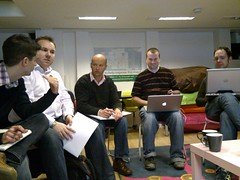 As genuine enthusiasts, the RC team have been an unusually engaged customer; we've taken advantage of this to involve them very closely in their product development. They've spent a half-day at FPHQ every couple of weeks, during which our team have demonstrated progress from the previous fortnight and had feedback, we've looked at the big picture of the project as a whole, and planned in the coming fortnight of work. We've always made efforts to be transparent with customers, but having them in the room with the team has made a significant positive difference to the product, the process, and the relationship. In future I'm looking forward to this style of collaboration being the norm for us, rather than the exception.
There's a suite of game mechanics lurking inside the app, but a really interesting aspect of the product is its use of live data - in fact the game can only be played live. We've long felt there's something interesting about mobile as a second screen for broadcast or events, and in many ways this feels like a natural progression of the work we did with the Ghost Detector in the US a few years ago. We think there's a lot of mileage here, and you'll be seeing a lot of activity in mobile as a second screen in the next few years.
You'll notice that what we've launched is "Roulette Cricket Lite"; there's more to come and we're beavering away on the next release, which will bring a load more features and refinements. In the meantime, we and Roulette Cricket are very interested in feedback from players; so please do download, have a game, and let us know what you think!
Kudos must go to the folks at FP who've been putting their heart and soul into this for the last few months: Douglas Hoskins, James Hugman, John Revill, Ben Carias, Trevor May, and Sergio Falletti.
UXCampLondon
April 18, 2010 | Comments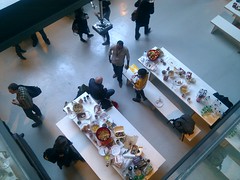 UXCampLondon 1.5 was quite fun. Held at the extravagantly spacious offices of LBi on Brick Lane, with security provided by elite attack badgers, attendance was down a little from last years event: ash stopped play for a few people.
I'd completely failed to write a presentation in time, so instead ran a little fishbowl-style discussion on something that's been gently nagging at me for a few months: what the intimacy of mobile as a medium might mean for the products and services we build on it. These physically close and available devices are simultaneously private (storing in-depth personal information) and public (as status symbols and loudspeakers); and as touch interfaces become more commonplace, the basic mechanisms for interacting with them become less intellectual and more instinctual: witness the speed with which any 4-year old gets to grip with an iPhone.
As a format, Fishbowl worked quite nicely: we heard opinion from across the 10 or so attendees without anyone jockeying to speak or being talked over. I found simultaneously facilitating and trying to contribute a bit icky (as usual). I've stuck my notes from the session here and here, but to put a bit more meat on their bones:
- Despite being intimate, mobile is often a proxy for intimacy - a means of avoiding or substituting for it.
- Sharing a mobile in the UK is something we're fairly uncomfortable with; in other cultures it's quite natural.
- As use of sensors for data capture increases and we start to gather, say, in-depth health information what happens to all this data? Who secures it, retains it, and how?
- We ended up splitting device ownership from account ownership. Wouldn't it be good to be able to half-lock a device so when handing it to a friend, they can use it in a restricted fashion? The analogy of private browser in modern web browsers was used.
- Teenage shared use of mobiles, and group conversations around a single device as speakerphone, was brought out.
- AdrianH told a tale of owning iQuarium, and being forced to kill his pet fish when upgrading from the lite to full version.
- Where *is* data anyway? Is the idea of data having any sort of geographical location a bit passé?
- We build relationships with software over time, as we do with people.
I attended a few other sessions, all of them enjoyable, and walked away (after a post-event beer on Brick Lane) with a few tasty things to think about... Many thanks to all the organisers, attendees, and LBi for making it the day it was!