Guardian iPhone
December 18, 2009 | CommentsSo, I've had a few days now to fiddle with with Guardian iPhone app - and I'm liking it. In an attempt to stretch my ability for unbiased appraisal to snapping point, I thought I'd do a little comparison of it to our own (unofficial) Guardian Anywhere app, for Android devices.
Incidentally, we saw a nice little uptick in usage of the latter when the iPhone app launched - and we're currently cruising at 4000 downloads (with 1700 of those being active installs). Considering that our promotion for this was a blog post here, a single tweet, and a gloriously underfunded Adwords campaign (446 clicks delivered so far), we're pretty pleased.
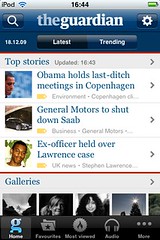 So, onto the comparison... looks-wise, I have to say I think the Guardian have done a much better job than us of replicating the brand, and the feel of print. The iPhone app feels like a newspaper, the Android app more like a database of stories. We've considered doing a more "papery" version for larger-screen devices like the Archos tablet, but it's unlikely to happen now - our attention is focused elsewhere for a little bit.
That said, I find the iPhone app a little "busy" - there's important navigation (search and settings) in the top corners, a navigation bar across the foot, a selector for latest and trending stories, and a feature that could be really useful (offline browsing) mixed into the foot of the main navigation. I could still find everything I wanted quickly (so my complaint feels a little churlish), but the overall sense was of extreme busyness - and I wasn't completely clear on the difference between "latest" and "trending".
Both apps make good use of the excellent pool of photography that the Guardian publish. But - and here's a key difference - from the iPhone app I can email a photo, and that's about it. On Android, I get the option to set as wallpaper or share the photo through a variety of mechanisms, highlighting one of the key advantages of the Guardian Anywhere (which is actually an advantage of Android as a platform): the interconnections between apps.
On my HTC Magic, I have apps for Facebook and Flickr installed. These apps then expose photo-sharing services to every other app on my phone - meaning that my copy of the Guardian Anywhere can automatically share photos with both of them, at zero effort for us, the developers. That's a really big win for me as a user: if I'm a member of a niche social network, my social networking app can help the Guardian Anywhere share content.
The same thing applies to the sharing of stories: I can post to Twitter easily from Guardian Anywhere, by virtue of having installed Twidroid. And I notice that within the stories themselves, links are stripped out on the iPhone (whilst being kept in on Android).
The iPhone app includes a whole load of audio content which is ace - I'm betting that more iPhone/iPod Touch owners listen to music on their devices than Android owners.
I was chuffed to see offline reading make it into the feature-set, though I can't help feeling that the value of it is reduced by the lack of running it at scheduled times in the background. One of the things I love about our Android app is that when I wake up, the news is already sitting there on my phone. With the iPhone, I have to tell the app to go grab the content now - which takes around 15 minutes. This just doesn't deliver the same sort of convenience, though lack of background processing on iPhone didn't leave the developers with any options.
I feel a mix of comfort and schadenfreude to see that downloading offline content takes about 15 minutes on the iPhone - it's the same for us on Android, and it's the number 1 complaint from our users. I'm confident that if the Guardian haven't solved this problem themselves, it's not so bad that we haven't yet...
And finally, there's distribution. I can't help but point out that the Guardian Anywhere is free, and available globally. £2.39 isn't an extremely reasonable price-point for such a high-quality iPhone app, but it's not available outside the UK, US and Canada. Whilst most of our users are UK and US, we have a sizable long tail in France, Singapore, Germany, Australia, and quite a few others, making up around 12.5% of our users.
It feels strange - a comparison of two very similar apps on Android and iPhone has ended up being a comparison of the platforms themselves, with iPhone delivering a superior overall look and feel (at a small but reasonable price) and Android making better use of background processing and connectivity between applications to improve the experience, for everyone.
Fragmentation, Android and iPhone
December 17, 2009 | CommentsRuss wrote a nice post a month or so back about the splintering of Android.
He's right, I think - we are starting to see fragmentation around Android. When new handsets or versions of the operating system launch, we find ourselves getting occasional small bug reports for our Guardian Anywhere product. Some of these bugs have been down to our not doing things in a standards-based fashion; some are down to differences in handsets (the Tattoo, for instance, has a much smaller screen than most other devices); and some... some we can't quite get to the bottom of.
And of course, it's not just the handset. In an application-rich world, every user has a different combination of apps, and Android's architecture allows them to run many apps at the same time - all of which might interact with one another, leading to difficult-to-reproduce edge cases. I'm also expecting to see issues caused by handset customisation (which operators are doing a great deal of - the T-Mobile Pulse is a nice example of this, and it's still early days)
So there is fragmentation in Android; but I was pleased last year to see Google quietly move from the naive line that "fragmentation won't happen, because it's not in the industry's interest" to "we'll introduce conformance tests for OEMs to avoid fragmentation". This seems to be paying off, so far - in that moving Android applications to new devices, even those with new screen sizes, is orders-of-magnitude less painful than moving between J2ME handsets from different manufacturers. That said, developers still need to do some work to provide graceful degradation.
Apple have done a fantastic job of presenting the iPhone as a single platform. There however, the reality is slightly different: 3 generations of hardware, 26 operating system releases (last time I counted), and a platform which in some incarnations has (or doesn't have) GPS, a loudspeaker, a microphone, or even a SIM card and therefore connectivity. Apple have done a great job of upgrading operating system versions to keep its installed base current, but even there there's some lag. The problem is at least finite, Apple being a closed ecosystem for hardware; and the lack of background apps helps developers avoid issues caused by interactions between applications.
So where does this leave us?
- Fragmentation isn't going away. Not until OEMs stop innovating and differentiating their products;
- Even wunderkinds of the tech industries like Apple and Google can't solve the problem for us. Even their kit - whether it be strictly controlled or lovingly curated - suffers from the issue, whatever you might hear to the contrary;
- As an industry we're getting better at dealing with it: platform vendors are taking more care, developers are evolving techniques and technology to cope;
- For those of us taking mobile products to market, testing across a range of devices is going to be something we continue to do as a matter of course - and we'll still be learning more than we ever wanted to know about weird handset bugs and software versions;
Many thanks to James Hugdroid, who proof-read, sanity-checked, and contributed to this post.
Update: Google have published a really nice analysis of deployed Android versions, implying that developers should be targeting 3 versions of the Android operating system.
Clutter-b-gone
December 08, 2009 | Comments- When is it inappropriate to use your iPhone - a romance flowchart;
- All hail the iPod touch; isn't it kinda amusing that one of the most popular mobile devices is completely disconnected from any traditional mobile network? Kinda says something about the telecomms industry I think;
- Is modern web design too like print design: "It feels like we’ve lost the “webness” of web design over an incredibly short period". Absolutely agree. We seem to have falled into a bit of a rut as far as our expectations of web design go...
- Very interesting report of the post-mortem for a large iPhone project;
- Node.js, an asynchronous framework for web applications. Can't decide if this is really cute (performance suggests so), or insanely evil (in that it seems to be retrofitting the WWW with select() calls)...
- If you're a fluent Japanese speaker, perhaps you could tell me what I'm talking about here? It's one of the interviews from my week in Japan...
- Simple and gorgeous - PhotoCard for the iPhone, an app to send email or physical postcards.
- I Blame The Designer: "Of course clients aren’t skilled designers; that’s why they had the foresight to hire us. But you know what? They know business. They’re as passionate, committed and talented as anyone. Many of them put their livelihoods on the line to make the web happen. And let’s be blunt: they also pay our salaries.". Bravo!
The Worlds Largest Multi Touch Wall 34 Million Pixels Generated By 15 High Definition Projectors Supported By Sound Prod
December 04, 2009 | Comments- The worlds largest multi-touch wall: "34 million pixels generated by 15 high definition projectors, supported by sound produced by 30 directional speakers"
- Twitter beard!: "just insert your face"
- Why your friends have more friends than you do: "You are more likely to be friends with someone who has more friends than with someone who has fewer friends"
- Cheap, Easy Audio Transcription with Mechanical Turk: "my 36-minute recording was transcribed while I slept, in less than three hours, for a grand total of $15.40"
- Opera Face Gestures: "lets you perform frequent browsing operations with natural and easy to make face gestures"
- Interesting post on design decisions behind Skype Chat, the best IM out there I reckon
- Differentiated presence on GMail chat status, nice touch: "when you know the guy on the other end is using his Android phone, you may decide to send shorter, more concise chat messages"
- How rich are you? Humbling.
- Square looks cute - the use of the headphone jack is particularly lovely, and I could see it getting uptake from smartphone owners (particularly if the customer hardware becomes fashionable or desirable), but I wonder how they plan to get the merchant side of the infrastructure rolled out to the extent that it's worthwhile.
- Via Dom, Appvent Calendar - a free iPhone game every day. Cute.
- The two use-cases of mobile - amen;
Its Gone Quickly Micro Updates For The Last Couple Of Days I Actually Made It Over To Hombu Dojo And Trained With Kurib
November 22, 2009 | Comments It's gone quickly. Micro-updates for the last couple of days:
- I actually made it over to Hombu dojo and trained with Kuribayashi sensei. Really good fun, very friendly class (about 25% Westerners as far as I could tell), not as austere as I'd feared. Hombu mats are unusually hard and *really* slippery. I found the class very tough to follow, not speaking a word of Japanese - but everyone was very friendly and I partnered with a succession of grinning yudansha who took pity on me. Sensei came over and used me for uke at one point, commenting that was I too focused on one thing. I'll try and work that one out...
- Kiddyland has eaten my wallet - thanks for dumping that one on me, Julie... it's basically the worlds best toy shop, 7 floors of really cool shit. I particularly enjoyed the Star Wars and Ghibli floors on each of my visits.
- After moving hotel (from the Grand Prince Akasaka to the Diamond) I popped over to Ueno zoological gardens yesterday and meandered around the zoo itself. The giant panda is gone (relatively recently, judging by all the signs apologising for the lack of a giant panda) but there's a good selection of bears (polar and grizzly), a dead cute red panda (think panda/raccoon cross but twice as cute), gorillas and some fun otters.
- Woke up at 3:30am this morning (again) and took advantage of the early start to head down to the fish market at Tsukiji and grab some breakfast. I missed the famous tuna auction, but had a delicious plate of fresh fishness at a little street-side cafe type thing which has set me up nicely for the day. One thing I've noticed on this trip is how much more relaxing it is to wander around an unfamiliar town with a GPS-enabled map... I've had close-to-zero worry of getting lost which makes the whole experience much smoother...
 Today's my last day in Tokyo - I have an extremely early start tomorrow, and haven't quite worked out how to make it to Narita airport on time. But chuffing me currently is that I've managed to get back in contact with an old Brighton chum who I last saw on my last visit to Tokyo, 9 years ago. So hopefully beers to follow there...