Sprint 41: review and retrospective
July 02, 2009 | Comments"In Sprint 41, I invented the bun... I invented the bun, in Sprint 41..."
What we learned:
- You need to be disciplined to get acceptance tests written before development starts on them;
- You need many strategies for communicating with remote teams: not all of them will work in any given situation;
- Retrospective actions need following up, or the whole exercise is of moot value;
- The current UK heat-wave causes problems and opens up opportunities :)
Another write-up of one of our planning days; Glastonbury having abducted our facilitatrix, I was running the review and retrospective sessions. This is undoubtedly a good thing for me to have more practice doing, but I worry about my ability to remain objective when wearing MD and Scrum Master hats, and having some opinions about the Way Things Ought To Be.
Worryingly (scrum smell ahoy!) there was little in the way of production software to show off at the review. Both teams had been working on one project (predominately), and in both cases a couple of large features were nearly-done, but not done done done - mainly due to dependencies on a third party which we're having trouble sorting out in a speedy manner, though in the case of Tonberry they had everything done for one story bar the automated tests. I'm hopeful that this means at the end of Sprint 42 we'll be inundated with new features to show off - i.e. that over 2 2-week sprints we'll have averaged out a little.
Ali showed off some of the widget work he's been doing recently for a new client (more on that in due course, I hope), and we had a good clutch of gold cards: Doug's produced another mobile application for alcoholics ("wake me up when my train gets home"), Chris had been doing some investigations into persistent storage efficiency using our Cactus database components for J2ME, and Tariq had some work on an Android app.
I've been worried about following up actions agreed at retrospectives - or rather, my not following them up as diligently as I should've been: there's little point in regularly agreeing to do stuff if it never gets done. So I kicked off the retro with a review of actions from the last time, highlighting the ones we've done and not yet gotten around to. I get the sense the strike rate was slightly higher, but I need to concentrate more on this in upcoming sprints.
Then the retrospective proper. I returned to a fairly standard format: each team member calling out 4 memorable moments from the previous sprint and getting them up onto a timeline. This brings out areas of common opinion or feeling from the team - unsurprisingly, many of us were pretty worried when one of the guys was taken into hospital at short notice, but environmental concerns about office temperature in the current heatwave were also a common theme, as was the visit a few of us made to Berlin on Monday. Some bug-fixing on an oldish project provided a boost to a few of us; stories not being finished provided a more sombre end-note to the sprint.
Having reached and discussed a group consensus on the previous 2 weeks, we moved onto actions, with each team member voting for something we should do in the immediate future, something we shouldn't do, and something we just don't understand. We then grouped these, discussed them and came out with a few to follow up on this sprint:
- We're becoming one team; with much of our work over the next couple of months being on a particular large project, we're combining the two development teams into one and sharing stand-ups and planning. A particular hope of mine is that this will encourage a lot more pairing up - 6 people can form many more combination of pairs than 3 - leading to a bit of variety, and a quicker path to getting those new to the project up to speed with i.
- We'd slacked off on a practice everyone had agreed had value, and worked well for us: writing acceptance tests for a story at the start of its development, and involving developers, QA, designers and the Product Owner in this session. Efforts are accordingly being redoubled in this department.
- A hot working environment is unpleasant: Thom was tasked to look into possible coolants.
- The speed of communication with a remote customer was highlighted as an issue by the team. I'm quite proud of the quantity of work we've done in the past, working with teams in London, Denmark, Helsinki or China... and past post-project retrospectives have highlighted the value of shortening decision times, so we've lots of little tricks we can use to ease the pain here. Recently we'd hit some problems which they weren't helping with, so we opted to raise the issue with the customer.
Other things we discussed included ways to improve our test automation (with some interesting suggestions floating for ways to document and improve test coverage of the user-interface elements of MIDlets or other mobile apps), and the need (or otherwise) to re-estimate stories before planning. The latter ended up with quite a long-running and heated debate (of the type we try and avoid having normally in retrospectives). I'm not convinced we got to the end of it but it feels like concerns have at least been aired. I posted round a Mike Cohn blog entry on the topic afterwards, which summed up the way I felt, but much more eloquently than I could put it.
Other observations I'd have: sprint burndowns don't seem to be so handy for us. They don't often get referred to and in some cases haven't been updated too frequently. I'm not sure what to do here: I think our story sizing relative to team capacity might be a bit off, and perhaps a larger team will make a difference.
We're Googly as fuck nowadays - we don't tend to move without creating a spreadsheet or document about it, and seem to have settled on it as our standard means of electronic collaboration.
And finally, we're holding standups outside for this sprint - partly to deal with the heat, and partly to recognise that with a team of 8-10, finding a board we can cluster around and actually refer to is tough with our current office configuration...
Designers, Developers and QA: FP needs you!
June 29, 2009 | CommentsSo, it's that time again. We're exceptionally busy and have won a few new projects and clients in the last month or two - with no sign of business slowing. So we're on the look-out for staff again. We're after a few different souls:
- Developers, ideally with some commercial experience of mobile (J2ME, Android or iPhone), and familiarity with or experience working in an agile environment (if you read this blog you'll know we're a quite formal Scrum shop). You'll have a strong appreciation for the role user experience plays in the software development process. You'll obviously be excellent.
- Mid- to senior-level designers; we'd be open to considering someone without commercial mobile experience, but you'll definitely need a strong background in digital media and a genuine enthusiasm for mobile. We're after someone with a mix of visual and interaction skills - we think the line between the two is blurred, and we like it that way. You'll have to be willing to get your hands dirty and learn a little about how your designs are actually implemented. Strong communication skills will be vital.
- QA - and specifically, someone interested in QA as a career path in its own right, rather than seeing it as a stepping stone to a development job. Over the last couple of years we've developed a huge appreciation for thorough, pedantic, devious, downright cruel QA folks who can find obscure bugs with which to taunt our developers, all in the nicest possible way of course. Someone with experience of both manual and automated testing would be a bonus; double points if you've worked in an agile environment before.
Mobile 2.0
June 28, 2009 | CommentsSo, it's been a week since I got back from Mobile 2.0 - and therefore highly remiss that I've not written about it yet.
I really enjoyed both the Developer Day and the main event. The former seemed to be focused around mobile web - with widgets in particular getting a lot of prominence. Whilst I'm not convinced that widgets are the future of all mobile apps, it's an area where - until recently - I've let myself lag behind a little, so I got a lot out of the sessions. And one quote from the very beginning has stuck with me - Dan Appelquist remarking that applications are nowadays being consumed more like songs than software.
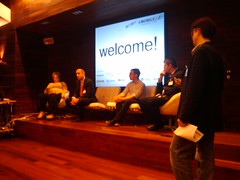
The main event was pretty decent. On both days some panel discussions had a tendency to get a bit angels-on-pinheads - the one where 4 people debated publicly about who was most "open", each using a slightly different definition of the much overused word, didn't really hold my attention. But the off-track talks really shone for me - Tom Raftery berating the industry for its at best token gestures towards environmentalism, and Regine Beatty and Atau Tanaka one-upping each other with wonderful examples of mobile frivolity. And outside of these, Ted Morgan of Skyhook talking about their business (200m location searches a day, vs 300m or so Google searches per day!) and Priya Prakash's talk on Beyond Free (an evolution of the last few sessions I've seen her do) were particularly memorable.
The venues (Barcelona Activa and ESADE) were both excellent (modulo the temperature of rooms in the former, which got quite stuffy). Now I've experienced the double-whammy of rock-solid wi-fi and power at every seat, I suspect I'm going to be a little spoilt.
More than this though, on a personal level I got a lot out of the event. It seemed to have a perfect mix of 50% familiar faces and 50% new (and friendly) ones - I'm not a natural networker, but felt very comfortable at the event. And in particular it was great to finally meet Dom and Francois of the W3C and Mike Rowehl - all of whom I've known for a while, but only in a virtual sense. It's nice to have that corrected :)
I did a couple of sessions; one on Mobile User Experience for Developer Day, which was well attended but missed the mark a little, I felt. I emphasised how we run UX alongside development at FP over and above the specifics of mobile UX, and whilst my audience seemed happy to engage on this, I think I could've either been clearer in the title for the session, or put more emphasis on tactics than on process.
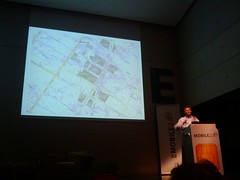 The "play" panel I sat on at the very end of the event was a different matter: really good fun, and an utter privilege to talk about location-based gaming, ghost hunting, shitting and sex, generative music and digital rights issues with Professor Tanaka, Gustav Soderstrom of Spotify, Akhil Monappa of Atlas Venture, and Michael Breidenbruecker - the lovable nutter behind Last.fm and RJDJ - all ably held together by Robin Wauters of TechCrunch.
And again, on a personal note I had a very interesting chat with Ted Morgan at the post-event dinner, learning exactly what it's like to get into work one day and find a message from Steve Jobs on your voicemail :)
Thanks to Rudy, Dan, and all the organisers and behind-the-scenes folks who made it happen. I'm already looking forward to next year, though I think I might give myself an extra day in Barcelona to help recover from Sonar...
Mobile 2.0: Beyond Free, Panel
June 20, 2009 | CommentsMobile 2.0: Beyond Free, Panel
Moderator: Inma Martinez, Stradbroke
Harald Neidhardt, Smaato
Fee Beyer, Berlin
Ian Ginn, Amsterdam
Dr Lai Kok Fung, BuzzCity
Priya Prakash, Nokia
IM: It's hard to fund mobile-specific busines
IM: What digital goods are being sold for a decent price?
PP: It depends on context. What goods are being sold on ebay?
PP: There's a distinction between creating an application and a service. In the song analogy, it's like being a creative musician. Anyone know of any apps which are service-like?
IM: There's a company in Madrid who does betting on mobile goods. They auction cars, games consoles, by text message: you bid for the ident, lowest price.
IM: What are the services worth paying for?
FB: Infrastructure companies like Orbster ("infrastructure on the phone").
IM: Imagine your service complementing others, so the uptake of users is faster. What elements are worth paying for? PP stresses UI...
PP: It's not just about the UI, that's where we're going wrong. UI can be lipstick on a pig. It's the whole ecosystem, there's as much design in the business model as in the presentation layer.
FB: To push a service through the operator organisation is very different.
IM: So many people create nice applications, but not apps you'd want to pay for.
LKF: In some emerging markets, we saw mobile banking as strong.
Q (Andrew Scott, Rummble): You need to focus on product, not revenue.
Q: (Martin, Layar) How should we charge?
IG: It feels like a killer app. I'd make a 30m drama about it to get the story out.
LKF: Make it work on all phones.
PP: Think about the discovery - who's going to help me find it?
IG: Make it newsworthy. Save a life with it, get it on the news.
Q: I keep hearing talk about money. But I like the iPhone because people can make an app without having money, and release it to a community - for social capital. Why do we focus on financial game? Why can't we help make life better?
A: If you're talking about a venture funded business, VCs have a different model. Bootstrap, don't talk to a VC - unless you're making something beyond amazing or your team has already done it before, your valuation will be so low... VCs are banks. The app store today is a good model for small developers, or Salesforce etc (having a mobile implementation of a pre-existing platform online).
Mobile 2.0: Tom Raftery on Mobile Sustainability
June 19, 2009 | CommentsMobile 2.0: Tom Raftery on Mobile Sustainability
greenmonk.net
Drivers for sustainability: climate change (we're all fucked) and the business case (sustainable companies tend to outperform their competitors).
ICT could reduce 15% CO2 emissions globally: through 1bn PCs, 1.2bn landlines, 1.4bn internet users, 4bn mobile users. So mobile is the target for this stuff.
Handset manufacturers are doing sod all: they all have "a green phone".
Many carriers don't mention sustainability initiatives: O2 have a reasonable site, Telefonica and 3 don't.
What are developers doing? Clearstandards have an iPhone app to calculate carbon footprint. 3rdWhale, MobiMonster also get a mention - the latter reduces energy usage of phone. But nothing really significant.
What if:
- Manufacturers made phones to last 6y not 6m? 60% of a phones carbon footprint comes from manufacture. Rent phones, don't buy them.
- Phones were made from biodegradables?
- USB chargers were standard?
- Operators switched to e-billing?
- Operators shared networks?
- Developers used mobile platform to build apps which mae a difference?
- Grid computing client apps were made for mobiles?
I wonder... How does mobile compare to PC - are phones implicitly more energy-conservative? And what specifically can developers do?